
Implant Placement

Why Implant Placement Matters
When you choose breast augmentation, one of the most important decisions is where the implant will sit in your body. This is called the implant pocket, and it affects how your breasts look, how they feel, and your long-term results.
There are two main options:
- Partly under the muscle (dual-plane) — our preferred technique
- On top of the muscle (subglandular)
While each approach has its place, dual-plane placement is the technique we recommend for most patients because it offers the best balance of natural appearance, long-term softness, and safety.
What Does Each Option Mean?
Partly Under the Muscle (Dual-Plane) — Our Preferred Technique
The implant is placed partially under the chest muscle, with the lower part allowed to sit more naturally under the breast tissue. This is the most commonly chosen approach in our practice.
- Excellent upper breast coverage, giving a smooth, natural upper contour — especially important for thinner patients
- Lowest chance of scar tissue forming around the implant (capsular contracture), which keeps the breast feeling soft long-term
- Reduced visibility of the implant edge and rippling
- Well-suited for most body types, including patients with thinner skin, mild sagging, asymmetry, or a narrower breast shape
- Can cause subtle breast movement when you flex your chest muscles, though this is usually minimal and not bothersome
On Top of the Muscle (Subglandular)
The implant is placed just under the breast tissue, above the chest muscle.
- Faster initial recovery
- No movement distortion with muscle activity
- Works best in patients with a good amount of natural breast tissue and body fat
- Higher chance of capsular contracture, which can make the breast feel firm
- More likely to feel or see the edge of the implant, especially in thinner patients
How Do Complications Compare?
Current research (looking at over 51,000 patients) shows how often certain problems happen with each type of placement:
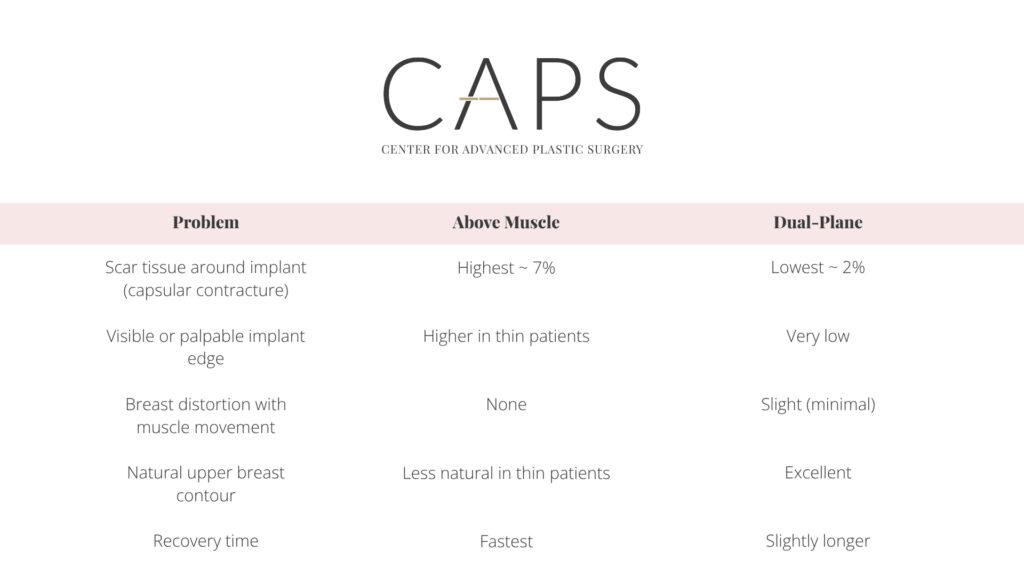
Why We Prefer Dual-Plane Placement
Dual-plane placement has become the gold-standard approach in modern breast augmentation for most patients. Here’s why we choose it for the majority of our patients:
- Superior aesthetics: the muscle covers the upper part of the implant, creating a natural slope rather than a visible implant edge
- Softest, most natural feel over the long term, thanks to a lower rate of capsular contracture
- Better suited to the wide range of body shapes we see — from thin patients to those with mild sagging or asymmetry
- Well-established safety profile backed by decades of surgical experience and large clinical studies
Is Dual-Plane Right for Everyone?
Dual-plane placement is our preferred technique for most patients, but there are some situations where we may discuss alternatives:
- Very athletic patients with specific muscle-activity concerns
- Patients with a thick layer of natural breast tissue who prefer placement above the muscle
- Certain anatomic considerations that your surgeon will discuss with you
Your surgeon will explain which approach is best for your body and goals.
Questions to Ask Your Surgeon
- Why is dual-plane placement recommended for me?
- What are the specific risks and benefits for my body shape?
- What should I expect during recovery?
- How does this placement affect breastfeeding or mammograms in the future?
- What follow-up care is needed?
Take-Home Message
Dual-plane placement is our preferred approach because it delivers natural, beautiful results with an excellent long-term safety profile. While every patient is different, this technique gives most patients the smoothest contour, softest feel, and best long-term outcome.
Your surgeon will review your specific anatomy and goals with you to confirm that dual-plane is the best choice for you.
